Thursday, April 7, 2011

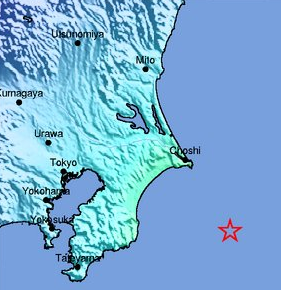
7.4 Quake in Japan


Here we go again: a 7.4 earthquake has struck Japan, just off the coast of the Miyagi prefecture. There is now a tsunami warning in effect for the country's northeastern coast, which is still recovering from last month's quakes and tsunami.

The current warning predicts a potential tsunami of as much as four feet.

The quake is only 73 miles from Fukushima, and it's being reported that buildings shook and windows broke as far away as Tokyo, which is 207 miles away. No word yet on how badly the melting nuclear reactors have been affected by this latest quake.

Saturday, April 2, 2011

A Year's Worth of Radiation, Every Four Days


This Greenpeace video shows live demonstrations of geiger-counter readings being done many miles away from Fukushima, and yet the radiation exposure is far higher than what is being admitted to in the mainstream media.

According to the Greenpeace volunteer in the video, the citizens living in this area are receiving the maximum amount of radiation a human should receive in a year, in about four days.

And yet, there has been no mass evacuation of these outlying areas. The Japanese government is lying when it says there is no cause for alarm for these citizens. These people are essentially being left to die, in order to avoid a mass panic. If there was ever a time when a mass panic was a good thing, we'd say it would be now. Since these readings are off the scale (note the counter only goes to 9999) and unmeasurably high, it may even be more dire than Greenpeace is estimating.

Friday, April 1, 2011

Japanese Radioactive Materials Polluting Ocean


Japan Times: "Tokyo Electric Co. came under further fire Friday after it was revealed that many of its employees at the damaged Fukushima No. 1 power plant have been working without the protection of dosimeters. It also said radioactivity in groundwater under the compound spiked."

Radio Free Liberty: "It has already leaked into the ocean, with levels continuing to spike several hundred meters offshore."

Daily Beast: "With highly radioactive water now leaking from the reactors into the Pacific, and levels of radioactive iodine and cesium in the sea near the plant as much as 4,000 times higher than normal, the safety of seafood—and of sushi in particular—has risen on the list of concerns not only in Japan but around the world."

Thursday, March 24, 2011

20,000 Penguins Endangered by Oil Slick


From AFP:

CAPE TOWN — A race to rescue up to 20,000 endangered penguins from an oil spill in an isolated south Atlantic British island group was underway Thursday after a cargo ship ran aground.

Oil-slicked Rockhopper penguins were being collected and taken off three Tristan da Cunha islands to the main island to be stored in a shed for treatment, cleaning and eventual release.

"Five hundred Rockhoppers were brought ashore on Tristan this morning," Tristin da Cunha administrator Sean Burns said in an online statement.

But specialist cleaning fluid was in short supply and hinged on a second ship being chartered from Cape Town, a journey of several days over 2,800 kilometres (1,740 miles), after a salvage vessel arrived on Monday.

"A crucial next step is to confirm a second vessel to depart from Cape Town in the next few days with all the necessary equipment and supplies to clean up the birds, keep them healthy and hopefully return them to the ocean," said Burns.

"It will be a race against time," he added.

Tristan da Cunha, a volcanically active island in the South Atlantic Ocean, is often said to be "the world's most remote inhabited location". (I suppose they mean other than polar expedition stations.)

In addition to the main island, the Tristan da Cunha family of islands also includes the uninhabited Nightingale Islands (where the oil spill caused by the bulk freighter Oliva occurred), Gough Island, and Inaccessible Island.

Sunday, March 20, 2011

The BP Disaster Never Ended


From Stuart H. Smith:

A large oil slick – 12-miles wide by 100-miles long – was spotted yesterday off Grand Isle, Louisiana, by pilot Bonny Schumaker, who heads up the California-based environmental nonprofit “On Wings of Care.” Ms. Schumaker confirmed that the slick is rapidly expanding, and reports that she will be returning to the site as soon as possible to further investigate the situation. New Orleans photographer Jerry Moran, who was flying with Schumaker, filed aerial photos.

This new oil spill is New Huge Spill is in the undersea Mississsippi Canyon System - the same area as BP's Deepwater Horizon disaster.

Throughout the month of February, Corexit and other dispersants have still been sprayed in the Gulf and many people asked themselves why this would be necessary. After all BP and the Government assured us the well was capped and the danger was over, right? But reports of huge undersea cracks still seeping oil from the sea floor remained. And now, the evidence is too huge to cover up: the oil is obviously still leaking, and if throwing more dispersant at it is their only solution, then it appears BP is powerless to stop the leak at its source (or sources).

Tuesday, March 15, 2011

Japan's Shifting Soil


The first of the two recent Japanese earthquakes (which has now been upgraded to a 9.1 magnitude, making it the fourth largest recorded since 1900) was caused when the Pacific Plate moved under the North American Plate.

This, in turn, nudged Japan 13 feet closer towards North America (see image, showing before-and-after, courtesy of NASA). The earthquake also shifted Earth on its axis by 6.5 inches, and shortened the day by 1.6 microseconds by making the Earth spin faster, Most disturbing of all, Japan sank downward into the ocean by at least two feet.

Soil liquefaction, which has always been a problem in mainland Japan, is also exacerbated by the ongoing disaster. Tokyo Disneyland closed because of water seeping up from the ground in the immediate wake of the quake. And now with the entire population on radiation fallout alert, the future of the theme park is up in the air. Many parts of Japan's coastline are actually artificial, built on reclaimed land extended into the sea by man-made means. The side effects of this are only now coming back to haunt the Japanese people, as nature seems to be reclaiming it back.

The idea of Japan completely sinking into the ocean is one that's been heavily explored in science fiction, such as Nihon Chinbotsu. While the reality is not quite this dire - yet - the potential for further and even greater tectonic movement is indeed possible.

Update: as we were preparing this post, the alert came over the USGS wire that a third earthquake has taken place in Japan.

At this time, the quake is said to be a 5.7 and is just off the coast of Honshu.

Developing....

Nuclear Disaster Rated 6 out of 7


Andre-Claude Lacoste, president of the Nuclear Safety Authority (ASN), has announced the danger of the situation in Japan has now been raised to Level 6 alert. There are only 7 levels.

Level 7 has been reached only once in the world, when Chernobyl plant exploded in 1986.

Lacoste: "We are now in a situation different from that of yesterday. It is quite clear that we are at a level 6, which is intermediate between what happened at Three Mile Island and Chernobyl."

The problem with this analysis is that there was only one reactor involved in Chernobyl, and in Three Mile Island. We currently have six nuclear reactors in Japan in various states of increasingly critical condition. Clearly, the international rating system of the ASN needs be amended to include previously-unforeseen scenarios such as this. Or, as many have called for already today, simply declare this mess what it is - a Level 8.

Japanese Radiation Headed for U.S.


According to this source, radioactive fallout from Japan's failing nuclear reactors could reach the United States within days.

The image seen here is that of a weather forecast map from Hong Kong Obsevatory, with the green line being the forecast at an altitude of 1,500 meters. Alaska will be hit first by the wave of radioactive particles, if the predicted model of the prevailing winds holds true.

Another Earthquake in Japan


From NHK:

A powerful earthquake with a preliminary magnitude of 6.0 jolted central Japan on Tuesday night.

The Japan Meteorological Agency says the quake with an intensity of 6 plus on the Japanese seismic scale zero to 7 hit at 10:31 PM.

The focus of the quake is in the eastern part of Shizuoka Prefecture and is estimated to be at a depth of 10 kilometers.

Sunday, March 13, 2011

Shinmoedake Volcano Erupts


Earthquakes, aftershocks, tsunami, nuclear meltdowns, and now add volcanic eruption to the list of horrors visited upon Japan this week.

The Los Angeles Times is reporting that volcano Shinmoedake is now erupting again. Shinmoedake is on Japan's Kyushu island, which is about 950 miles from the epicenter of Friday's 8.9 earthquake.

Although the volcano has been relatively active in recent years, today's volcanic explosion is the worst in 52 years. According to the report, The volcano blast was loud enough to be heard for miles and the impact broke windows up to 4 miles away.

Japan's Nuclear Disaster Grows


As we predicted two days ago, the original "don't worry, everything's fine" picture presented by authorities in Japan is coming apart at the seams, along with the country's nuclear reactors.

From USA Today:

The quake and tsunami damaged three reactors at the Fukushima Dai-ichi nuclear plant, which lost their cooling functions necessary to keep the fuel rods functioning properly. At first the Unit 1 reactor was in trouble with an explosion destroying the walls of the room in which it is placed. Later, Unit 3 also began to experience problems.

Chief Cabinet Secretary Yukio Edano said operators released slightly radioactive air from Unit 3 Sunday, while injecting water into it as an effort to reduce pressure and temperature to save the reactor from a possible meltdown.

Still, a partial meltdown in the unit is "highly possible," he told reporters.

And the New York Times:

Japanese officials struggled on Sunday to contain a widening nuclear crisis in the aftermath of a devastating earthquake and tsunami, saying they presumed that partial meltdowns had occurred at two crippled reactors and that they were facing serious cooling problems at three more. The emergency appeared to be the worst involving a nuclear plant since the Chernobyl disaster 25 years ago. The developments at two separate nuclear plants prompted the evacuation of more than 200,000 people. [Meta-O note: this figure has since been upped to 250,000 at this hour.] The Japanese Nuclear and Industrial Safety Agency said that as many as 160 people may have been exposed to radiation around the plant, and Japanese news media said that three workers at the facility were suffering from full-on radiation sickness.

Friday, March 11, 2011

Japanese Quake Triggers Nuclear Emergency

In the wake of the 8.9 earthquake, the Herald Sun is reporting that a nuclear power plant in Japan has shut down and is unable to cool its reactor. MSNBC says it's two nuke plants. Monsters & Critics says five, and that a fire has broken out at one of them.

Although the official statements from the operators of said plants, and from the Japanese government, assure the public that all is well and that there is no danger, we remain skeptical. Prime Minister Naoto Kan said: "Parts of nuclear plants were automatically shut down but we haven't confirmed any effects induced by radioactive materials outside the facilities."

Developing...

Sunday, November 14, 2010

Underwater Robot Pulls Up Giant Isopod


Recently, when a deep-sea surveying company hoisted up their underwater robot-cam, they were surprised to see this enormous and rare specimen of Bathynomus giganteus had attached itself to it.

Bathynomus giganteus is a Isopod, one of the most diverse orders of crustaceans on the planet. Though this example is unusually large - two and a half feet long - some have been found even larger, and on the other end of the scale, some isopods are so tiny they're microscopic. They are direct cousins of the common Woodlouse which is, for many of us as children, our first experience with crustaceans. Isopods virtually identical to the ones we have today first appear in the fossil record about 300 million years ago.

Saturday, November 13, 2010

A New Indonesian Island Arises


From poleshift.ning.com:

"The increase in volcanic activity all over the world is frightening.

East of the Indonesian island Java, in the sea between Java and Bali, a new island has risen from nothing within a few days. It is probably of volcanic origin. The location is not so very far from Tambora.

West of Java the Anak Krakatoa is active, in the middle of Java the Merapi is very active and east of Java a new island has appeared in the sea, which wasn't there a few days ago. The fear of a coming mega-eruption is real."

Wednesday, November 3, 2010

Smell/Sight Test Doesn't Reveal Toxicity in Seafood


From Non-Profit Times:

The organization [Louisiana Environmental Action Network (LEAN)] has been increasingly concerned about the toxic combination of crude oil and dispersant, and Orr said LEAN has been sampling in the Mississippi River Delta, Oyster Bay in Louisiana, and the Lower Atchafalaya Bay Area.

Blue crab samples in the Atchafalaya Bay contained a dangerously high 8.815 mg/kg of hydrocarbons, for example, according to LEAN's reports.

"When we took samples, there was no visible smell or sight of oil," Orr said. "We were astonished there were levels like that. You can't eat a crab like that, with those levels of hydrocarbons."

The organization has been discussing seafood safety with the Food and Drug Administration (FDA), the EPA and the National Oceanic and Atmospheric Administration (NOAHH), and continuing to sample biota including mussels, crab, shrimp and fish. LEAN is in the process of creating a sampling plan for up to the next five years focusing on Louisiana, Orr said.
"I am really disturbed and I think the country is divided in its thought process," she said. "If you live away from the Gulf, you think everything is alright. If you live here, you know it's not alright."

Sunday, October 31, 2010

Harmful Bacteria Found in Rainwater

The results of a year-long rainwater study are in at the University of Bangalore, and it isn't good news.

The scientists found E coli, evidence of Streptococcus spp, Staphylococcus aureus, Enterococcus spp, Actinomyces spp, Bacillus subtilis, Neisseria spp, and Mycobacterium sp in samples of local rain and hail. They also found fungal species like Fusarium spp and Alternaria spp.

The presence of the fungi and bacteria known for causing, among other things, meningitis and necrotizing fascitis, in common rainwater directly challenges the skeptics who claim it's impossible for Corexit or BP's genetically-created oil-eating bacteria to be raining back down on the public as precipitation.

This is, no doubt, the reason our pals over at Florida Spill Law are on this story.... more to come.

Saturday, October 30, 2010

Martian Ocean Coming Into Focus


We now know that the planet Mars once had an enormous ocean that covered over a third of its surface, about 3.5 to 3.7 billion years ago, and now we also may be able to examine some remnants of it. The Mars Exploration Rover "Spirit", which is currently stuck and unable to move on the Martian surface, has nonetheless been able to glean much valuable data about its current location. It's found evidence of subsurface water beneath it, which may be snow melt or permafrost, but could possibly also be traces of the great body of water which once ruled the red planet.

Tuesday, October 26, 2010

BP's Synthetic Life Forms


We're still on the fence about the veracity of the "BP Blue Flu" scare story making the rounds online, but Michael Edward, on this World Vision Portal post, seems rather well-researched in his arguments and frightening conclusions.

We urge you to click through and read the entire article. Some excerpts:

In a paper published in the journal Science, Terry Hazen and his colleagues at Lawrence Berkeley National Laboratory discovered in late May through early June 2010 that a previously unknown species of cold-water hydrocarbon-eating bacteria have been feasting on the underwater oil plumes degrading them at accelerated rates.

We can now understand why, on May 15, BP/Synthetic Genome’s CEO Craig Venter hinted of a new hydrocarbon-eating synthetic genome. Prior to that date, JCVI had already applied for numerous additional patents (we were able to find seven) regarding synthetic bio-remediation, such as bacteria synthetic genomes which provide unique DNA information required for “replication of a free-living organism”. In layman’s terms, this means the BP and Synthetic Genome scientists had already created self-replicating bacteria “wherein the assembled DNA molecule is a [synthetic] genome” back in 2007...

Nothing is known about how this new synthetic bio-remediation bacterium in the Gulf reacts with mankind. This is virgin and uncharted territory. We already know how sea mammals such as whales and porpoises have reacted. Those who haven’t escaped the affected areas of the Gulf have died… along with all other marine life and coastal vegetation. While human health effects from crude oil exposure are well known, the effects of dispersants containing oil-eating artificial bacteria are not known. It’s never been done before, let alone at the immense scale of operations now taking place.

There’s a reason the so-called “dispersants” are guarded by weapon-yielding soldiers and local armed law enforcement in warehouses and deployment yards along the Gulf coast. If a sample were to be analyzed by knowledgeable people, the biological and chemical anomalies it contains would be made public, right down to the unique DNA signature. BP keeps allowing their sorcerer’s brew to be called Corexit in order to hide the fact that it’s not just the name brand product any longer.

The physical symptoms of the BP Flu, BP Crud, Blue Flu, or whatever name you choose to call it, are as unique as the synthetic bacteria being used in the Gulf. Since mankind is carbon based, how do these synthetically created hydrogen and carbon hungry bacteria react to human flesh? Internal bleeding as well as ulcerating skin lesions are the physical signs of their computer created DNA signature...

Tuesday, October 19, 2010

Only 3 Shrimp Tests in 3000 Square Miles!


From Huffington Post by way of Florida Oil Spill Law comes this datum that, at this late date, shouldn't come as too much of a surprise:

The Federal government has now reopened 2,927 square miles of the Gulf - specifically, an area just South of the Mississippi Delta - to fishing and shrimping boats. But in order to check whether it was safe to do, all they did was perform chemical tests on three samples of shrimp taken from that huge area! (They also did the ridiculous "sniff test" for petroleum odors on five shrimp samples.)

Neither the sniff test nor the chemical test are intended to detect the deadly dispersant Corexit that BP dumped into the ocean in staggering quantities, and the miniscule sampling the government has used to give the okay to such a vast portion of the Gulf is statistically meaningless.

The government's falsely cheerful assessment of the situation coincides with the revelation that University of Georgia scientists took 78 core samples of the Gulf seafloor, and only 5 contained live worms. Traditionally, live worms should have been found in every one of those samples.

Sunday, October 17, 2010

Super-Typhoon Megi Approaches Phillipines


From Channel NewsAsia:

BEIJING: Super typhoon Megi is expected to be the strongest typhoon of the year in China, as it intensified while approaching the northern Philippines on Sunday, forecasters said.

Super typhoon Megi, which means "catfish" in Korean, is expected to enter the South China Sea on Monday, China's National Meteorological Centre said in a statement.

Megi could cause wild winds and huge waves in the South China Sea over the next three days, the statement said.

The centre issued an orange alert, its second-highest level warning, telling ships to shelter in ports and urging local authorities to prepare for emergencies.


Megi will likely exceed winds of 260 MPH and be capable of destroying homes and uprooting large trees. Evacuation plans are being put into place for areas to be hardest hit.