Tuesday, May 4, 2010

Can the Ocean Withstand 3 Months of Spewing Oil?


From FOX News:

It will take at least three months to effectively stop the flow of oil rushing through a damaged well that is leaking oil into the Gulf of Mexico, Admiral Thad Allen, Commandant of the United States Coast Guard, and now National Incident Commander of the Gulf Coast oil spill said Monday morning.

Three months? But what will happen if this hole in the ocean floor continues to spew oil at its current rate? Opinions on the subject are ranging from alarmist to blasé. It's our reckoning here at Meta-Oceanic that the Deepwater Horizon crew have punched a hole in something that should never have been messed with, and now they have no clue how to stop it.

The oil spill is now the size of Delaware, and is growing at a frightening rate. According to one commenter's calculations on Reddit:

"If you take the surface area of all the unenclosed water on Earth as 139.480x10E6 sq mi, and you take this rate of spread (estimated from the satellite images between 3 days) then the ENTIRE EARTH WILL BE COVERED IN OIL IN 124.3 DAYS"

That's probably an extreme exaggeration, but no one can really say for certain - because nothing like this has ever happened in human history.

According to another scary report floating around the internet, allegedly written by an anonymous engineer, claims:

First, the BP platform was drilling for what they call deep oil. They go out where the ocean is about 5,000 feet deep and drill another 30,000 feet into the crust of the earth. This it right on the edge of what human technology can do. Well, this time they hit a pocket of oil at such high pressure that it burst all of their safety valves all the way up to the drilling rig and then caused the rig to explode and sink. Take a moment to grasp the import of that. The pressure behind this oil is so high that it destroyed the maximum effort of human science to contain it.

First they have to get the oil rig off the hole to get at it in order to try to cap it. Do you know the level of effort it will take to move that wrecked oil rig, sitting under 5,000 feet of water? That operation alone would take years and hundreds of millions to accomplish. Then, how do you cap that hole in the muddy ocean floor? There just is no way. No way.

If we can't cap that hole that oil is going to destroy the oceans of the world. It only takes one quart of motor oil to make 250,000 gallons of ocean water toxic to wildlife. Are you starting to get the magnitude of this?

The New York Times is reporting that lawyers for a worker who was on Deepwater Horizon at the time of the April 20 explosion had charged that the rig was drilling deeper than 22,000 feet, even though the company’s federal permit allowed it to go only to 18,000-20,000 feet deep. BP denies the claim. Halliburton, who are also said to be guilty of Earth-threatening malfeasance in this incident, also deny culpability.

Monday, April 26, 2010

Ocean Acidity Skyrocketing


The National Research Council has some pretty grim and sobering things to say about the state of the world's oceans.

The oceans have become more acidic in the last few years than at any time in human history. Oceans absorb about one-third of all human-generated carbon dioxide emissions, including those from burning fossil fuels, cement production and deforestation, the NRC report says.

From the Santiago Times:

“The chemistry of the ocean is changing at an unprecedented rate and magnitude due to anthropogenic carbon dioxide emissions,” the U.S. National Research Council said. “The rate of change exceeds any known to have occurred for at least the past hundreds of thousands of years.”

Ocean acidification eats away at coral reefs, interferes with some fish species' ability to find their homes and can hurt commercial shellfish such as mussels and oysters by reducing their ability to make their protective shells.

When carbon dioxide is absorbed by the oceans, it reacts with sea water to form carbonic acid. Unless human carbon dioxide emissions are curbed, oceans will grow more acidic, the report said.

Tuesday, April 13, 2010

Ocean Floor Rising 13 Feet A Day?


There's a Coral Sea tsunami station located at 14.803 S 153.585 E (14°48'9" S 153°35'6" E), and it's been in "event mode" ever since the large earthquakes recently occurred in the area. Apparently, the buoy is being triggered by anomalous water column height above the sea floor, and the data seems to show that the ocean floor beneath the buoy is rising at the alarming rate of thirteen feet per day. View the Coral Sea tide chart here.

The location is also close to the Vanuatu Islands, which have been abruptly volcanically hyperactive for several months now.

Monday, April 12, 2010

Deepest Undersea Vent Discovered in Caribbean


From Discovery:

Over three miles down in the ocean, where the Caribbean Sea's warm blue waters fade into lightless black, scientists have found something bizarre and wonderful: the deepest active hydrothermal vent system on the planet.

As incredible as the find itself are the details: the smokers spew water hot enough to melt lead. The smokers' waters are so packed with minerals that their two-story high chimneys are basically made of iron and copper ore. An and around the vents gardens of strange bacteria flourish.

The existence of life thriving in this, the most inhospitable conditions ever recorded, virtually proves the potential for life to exist on other planets, which often are composed of similar mineral-rich boiling chemical soups.

And just last month, a NASA team discovered higher life forms surviving beneath a 600-foot-deep Antarctic ice sheet.

Clearly, life is - and can be - everywhere and anywhere.

Sunday, April 11, 2010

7.1 Earthquake in Solomon Islands


From Xinhua:

A 7.1-magnitude earthquake struck the Solomon Islands on Sunday, the U.S. Geological Survey (USGS) reported Sunday with no immediate tsunami alert or reports of damage.

The Australian Broadcasting Company (ABC) quoted USGS as saying the quake's epicenter was 52 km deep, 97 km southwest of the Solomon Islands' Kira Kira in the Pacific Ocean. It hit at 8:40 p. m. local time.

ABC quoted Pacific Tsunami Warning Center as saying there was no destructive widespread tsunami threat, but it warned " Authorities in the region of the epicenter should be aware of this possibility and take action."

Friday, April 2, 2010

8.0 Earthquake Reported, Retracted


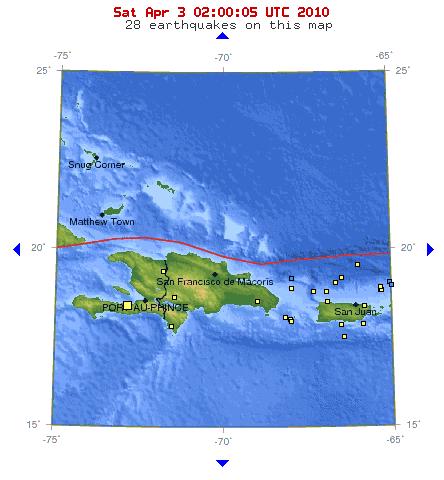
The USGS sent out an email report regarding an 8.0 quake near Higey, La Altagracia, Dominican Republic, but the internal link was broken.

Going directly to the USGS website shows no mention of the quake. Neither does a quick check of web, news, and blogosphere, which mainly consists of other people going "what the heck just happened?"

(Update: Apparently the report is indeed false.)

Undersea Volcano Could Destroy Italy


From The Australian:

Europe's largest undersea volcano could disintegrate and unleash a tsunami that would engulf southern Italy "at any time", a prominent vulcanologist has warned.
The Marsili volcano, which is bursting with magma, has "fragile walls" that could collapse, Enzo Boschi told the leading daily Corriere della Sera.

"It could even happen tomorrow," Prof Boschi, president of the National Institute of Geophysics and Volcanology said

"Our latest research shows that the volcano is not structurally solid, its walls are fragile, the magma chamber is of sizeable dimensions," he said.

"All that tells us that the volcano is active and could begin erupting at any time."

The event would result in "a strong tsunami that could strike the coasts of Campania, Calabria and Sicily," Prof Boschi said.

Thursday, April 1, 2010

Lord Howe Island's Bleached Reef Proves Climate Change


From ABC Australia:

Parts of the world's most southerly coral reef are under threat after it suffered its largest-recorded bleaching event.

Lord Howe Island is well known for its pristine environment and natural beauty.

The island's isolation has allowed it to develop unique and endemic marine life and the waters contain an unusual mix of tropical, sub-tropical and temperate corals.

But since January the waters around Lord Howe have experienced unusually warmer temperatures. The average rose by two degrees Celsius and the corals are showing the first signs of extensive bleaching.

And unlike the Great Barrier Reef, where corals have been known to recover, the genetically unique reef at Lord Howe could take decades to regenerate.

Peter Harrison from the Southern Cross University says it is the most significant bleaching event ever recorded at Lord Howe Island.

"The significance of this is that Lord Howe Island has the southern-most coral reef, so when that starts to see signs of extensive coral bleaching we know that the climate is definitely changing," he said.

Tuesday, March 30, 2010

The Search for Air France Flight 447


On June 1, 2009, Air France Flight 447 disappeared over the Atlantic Ocean. The aircraft departed from Rio de Janeiro on 31 May 2009 at 19:03 local time (22:03 UTC), with a scheduled arrival in Paris, France approximately 11 hours later.

The last verbal contact with Flight 447 was at 01:33 UTC, when it was near waypoint INTOL located 565 km (351 mi) off Natal, in Brazil's north-eastern coast.

Although some bodies and debris were found floating on the ocean's surface, the actual plane itself - and/or its black box flight recorder - have never been found. There was no last-minute message from the crew of flight 447, and we have no idea exactly where it disappeared.

This week, a new search begins for the missing plane, using some of the latest high-tech underwater equipment. The Woods Hole Oceanographic Institution will operate three unmanned deep-sea probes that, according to NPR:

"...run autonomously from any surface control tether and have the capability to dive down to full ocean depth... They were used in an unsuccessful underwater search for the plane that adventurer Amelia Earhart disappeared in 73 years ago. Each vehicle employs sea floor-scanning sonar, as well as cameras."

Friday, March 26, 2010

BPA from Plastics Pervades our Oceans


From Wired:

A survey of 200 sites in 20 countries around the world has found that bisphenol A, a synthetic compound that mimics estrogen and is linked to developmental disorders, is ubiquitous in Earth’s oceans.

Bisphenol A, or BPA, is found mostly in shatter-proof plastics and epoxy resins. Most people have trace amounts in their bodies, likely absorbed from food containers. Its hormone-mimicking properties make it a potent endocrine system disruptor.

In recent years, scientists have moved from studying BPA’s damaging effects in laboratory animals to linking it to heart disease, sterility and altered childhood development in humans. Many questions still remain about dosage effects and the full nature of those links, but in January the U.S. Food and Drug Administration announced that “recent studies provide reason for some concern about the potential effects of BPA on the brain, behavior, and prostate gland of fetuses, infants and children.”

One disturbing possibility is that BPA could bioaccumulate, with animals eating BPA-tainted animals that have eaten BPA-tainted animals, finally reaching high concentrations in top-level ocean predators and the humans who eat them.

Wednesday, March 24, 2010

Manatee Deaths Skyrocket Due To Cold


From ABC Action News:

TALLAHASEE, FL -- Florida Fish and Wildlife Officials announced Tuesday that due to the prolonged cold temperatures the past three months, 431 manatee deaths have already been documented.

Officials say exposure to low temperatures for a long period of time can cause a condition called "manatee cold-stress syndrome," which can result in death.

Last year the FWC documented 429 manatee deaths, which exceeded the highest number on record until now.

The Fish and Wildlife Research Institute Director said the rate of mortality so far this year is of great concern and that they will focus on determining the long-term implications for the manatee population.

Tuesday, March 23, 2010

Nanotech Seawater Desalination


Although large-scale, inefficient factory-sized plants to exist to process the salt out of salt water, the idea of cheap and portable system for individual use has always been a pipe dream. Until now.

From Nanowerk:

Freshwater could become the oil of the 21st century – scarce, expensive and fought over. While over 70 per cent of the Earth's surface is covered by water, most of it is unusable for human consumption.

Researchers have now demonstrated a new, efficient and fouling-free desalination process based on the ion concentration polarization (ICP) phenomenon – a fundamental electrochemical transport phenomenon that occurs when an ion current is passed through ion-selective membranes – for direct desalination of sea water.