Saturday, May 8, 2010

BP Oil Disaster Reaches Alabama?


Globs of tar are now washing up on the coast of Alabama, in the Dauphin Island area. The gooey muck has been collected by officials and sent to labs for analysis. It has not yet been conclusively determined whether the tar comes from the Deepwater Horizon incident, but according to Mayor Jeff Collier, "we certainly assume that to be the case."

BP spokesman John Curry had already confirmed that oil has impacted Freemason Island, just south of the Chandeleur Islands. Further reports followed with other sightings of oil washing up on the Chandeleur Islands.

Containment Dome Fails


Predictably enough, the containment dome that BP attempted to put in place over the spewing oil vent on the ocean floor has failed, and failed miserably. And if the situation weren't so grave, BP's response would be hilarious:

"I wouldn't say it's failed yet," BP chief operating officer Doug Suttles said. "What I would say is what we attempted to do ... didn't work."

BP officials said it would be at least Monday before they decide on what the next step to take would be. It took two weeks for engineers to hastily build this box and three days to bring it to the site. As predicted by many experts (including us), it didn't work. Frozen methane hydrate formations (referred to ominously in some press reports as "icelike crystals") rapidly built up on the surface and clogged the works.

The Deepwater Horizon oil-drilling rig exploded on April 20, killing 11 workers, about three weeks ago. Since then, approximately 210,000 gallons of crude a day has been flowing into the Gulf - and some estimates are placing the quantity much higher.

A group of BP corporate executives were on the platform when the incident occurred, and many were injured. Ironically, they were gathered there that day to celebrate the historic technological achievement they were undertaking, as well as pat themselves on the back for their safety record.

The Obama administration has vowed that BP will pay in full for the global mess they have caused, but most citizens are skeptical. After all, Obama also vowed to close the Guantanamo Bay detention camp.


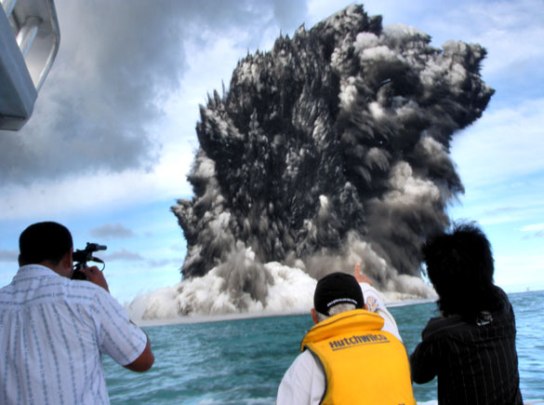
Photo: Sindh Today.

Thursday, May 6, 2010

Class Action Suit Against BP


There's going to be a lot more like this: A class action has been filed on behalf of all Louisiana commercial fishermen and charter boat operators who have suffered from the recent Deepwater Horizon disaster.

Defendants named in the complaint include BP, PLC, and BP America, Inc. (which owned the oil well), Transocean Offshore Deepwater Drilling, Inc. (which leased the oil rig to BP), Halliburton (which was engaged in cementing operations at the well), and Cameron International Corporation (which supplied the blowout preventer valves for the Deepwater Horizon oil rig that failed to activate.)

Get more details and see the complaint in full at The BP Oil Spill Legal Network.

Wednesday, May 5, 2010

Throwing Toxins at Toxins


As the New York Times puts it, BP is now "engaging in one of the largest and most aggressive experiments with chemical dispersants in the history of the country, and perhaps the world."

So far they've sprayed over 160,000 gallons of so-called "chemical dispersant" on the surface of the ocean above the Deepwater Horizon underwater oil leak. Furthermore, they've pumped an additional 6,000 gallons directly onto the leak itself. These chemicals - which is in themselves poisonous to marine life - are being judged as the lesser of two evils when compared to the oil.

We disagree.

First of all, the exact chemical makeup of these dispersants is unknown and is legally considered a "trade secret" by the corporations like Nalco that manufacture them. If BP is going to dump these toxic chemical mixtures into the ocean in a misguided effort to clean up the toxic chemicals they've already caused to contaminate the ocean, we believe the public has a right to know what's in them.

Secondly, the function of these dispersants is not to remove the oil, but to bind with it on the molecular level and break it down into super-tiny droplets. These droplets of oil then will be quickly assimilated into the ocean and "disappear" as they spread out. Just because you can no longer see the oil doesn't mean it isn't still there, and doesn't make it any less toxic.

From Bellona:

"...one of British Petroleum’s most guarded secrets was revealed today: what kind of dispersant they are using in clean-up efforts. It turns out to be toxic Corexit 9500, as clean-up workers here had earlier told Bellona.

That Corexit 9500 was being used by BP to disperse the spill was revealed by the dispersant's manufacturer, Nalco Holding Company of Naperville, Illinois. Nalco's CEO, Erik Frywald, today expressed his company’s commitment to "helping the people and environment of the Gulf Coast recover as rapidly as possible."

Corexit 9500 is associated with headaches, vomiting and reproductive problems as sides effects at high doses to clean-up workers. 2-BE has also been documented to cause the breakdown of red blood cells, leading to blood in urine and feces, and can damage the kidneys, liver, spleen and bone marrow of humans – effects not included on the information sheet for workers."

Tuesday, May 4, 2010

Can the Ocean Withstand 3 Months of Spewing Oil?


From FOX News:

It will take at least three months to effectively stop the flow of oil rushing through a damaged well that is leaking oil into the Gulf of Mexico, Admiral Thad Allen, Commandant of the United States Coast Guard, and now National Incident Commander of the Gulf Coast oil spill said Monday morning.

Three months? But what will happen if this hole in the ocean floor continues to spew oil at its current rate? Opinions on the subject are ranging from alarmist to blasé. It's our reckoning here at Meta-Oceanic that the Deepwater Horizon crew have punched a hole in something that should never have been messed with, and now they have no clue how to stop it.

The oil spill is now the size of Delaware, and is growing at a frightening rate. According to one commenter's calculations on Reddit:

"If you take the surface area of all the unenclosed water on Earth as 139.480x10E6 sq mi, and you take this rate of spread (estimated from the satellite images between 3 days) then the ENTIRE EARTH WILL BE COVERED IN OIL IN 124.3 DAYS"

That's probably an extreme exaggeration, but no one can really say for certain - because nothing like this has ever happened in human history.

According to another scary report floating around the internet, allegedly written by an anonymous engineer, claims:

First, the BP platform was drilling for what they call deep oil. They go out where the ocean is about 5,000 feet deep and drill another 30,000 feet into the crust of the earth. This it right on the edge of what human technology can do. Well, this time they hit a pocket of oil at such high pressure that it burst all of their safety valves all the way up to the drilling rig and then caused the rig to explode and sink. Take a moment to grasp the import of that. The pressure behind this oil is so high that it destroyed the maximum effort of human science to contain it.

First they have to get the oil rig off the hole to get at it in order to try to cap it. Do you know the level of effort it will take to move that wrecked oil rig, sitting under 5,000 feet of water? That operation alone would take years and hundreds of millions to accomplish. Then, how do you cap that hole in the muddy ocean floor? There just is no way. No way.

If we can't cap that hole that oil is going to destroy the oceans of the world. It only takes one quart of motor oil to make 250,000 gallons of ocean water toxic to wildlife. Are you starting to get the magnitude of this?

The New York Times is reporting that lawyers for a worker who was on Deepwater Horizon at the time of the April 20 explosion had charged that the rig was drilling deeper than 22,000 feet, even though the company’s federal permit allowed it to go only to 18,000-20,000 feet deep. BP denies the claim. Halliburton, who are also said to be guilty of Earth-threatening malfeasance in this incident, also deny culpability.

Monday, April 26, 2010

Ocean Acidity Skyrocketing


The National Research Council has some pretty grim and sobering things to say about the state of the world's oceans.

The oceans have become more acidic in the last few years than at any time in human history. Oceans absorb about one-third of all human-generated carbon dioxide emissions, including those from burning fossil fuels, cement production and deforestation, the NRC report says.

From the Santiago Times:

“The chemistry of the ocean is changing at an unprecedented rate and magnitude due to anthropogenic carbon dioxide emissions,” the U.S. National Research Council said. “The rate of change exceeds any known to have occurred for at least the past hundreds of thousands of years.”

Ocean acidification eats away at coral reefs, interferes with some fish species' ability to find their homes and can hurt commercial shellfish such as mussels and oysters by reducing their ability to make their protective shells.

When carbon dioxide is absorbed by the oceans, it reacts with sea water to form carbonic acid. Unless human carbon dioxide emissions are curbed, oceans will grow more acidic, the report said.

Tuesday, April 13, 2010

Ocean Floor Rising 13 Feet A Day?


There's a Coral Sea tsunami station located at 14.803 S 153.585 E (14°48'9" S 153°35'6" E), and it's been in "event mode" ever since the large earthquakes recently occurred in the area. Apparently, the buoy is being triggered by anomalous water column height above the sea floor, and the data seems to show that the ocean floor beneath the buoy is rising at the alarming rate of thirteen feet per day. View the Coral Sea tide chart here.

The location is also close to the Vanuatu Islands, which have been abruptly volcanically hyperactive for several months now.

Monday, April 12, 2010

Deepest Undersea Vent Discovered in Caribbean


From Discovery:

Over three miles down in the ocean, where the Caribbean Sea's warm blue waters fade into lightless black, scientists have found something bizarre and wonderful: the deepest active hydrothermal vent system on the planet.

As incredible as the find itself are the details: the smokers spew water hot enough to melt lead. The smokers' waters are so packed with minerals that their two-story high chimneys are basically made of iron and copper ore. An and around the vents gardens of strange bacteria flourish.

The existence of life thriving in this, the most inhospitable conditions ever recorded, virtually proves the potential for life to exist on other planets, which often are composed of similar mineral-rich boiling chemical soups.

And just last month, a NASA team discovered higher life forms surviving beneath a 600-foot-deep Antarctic ice sheet.

Clearly, life is - and can be - everywhere and anywhere.

Sunday, April 11, 2010

7.1 Earthquake in Solomon Islands


From Xinhua:

A 7.1-magnitude earthquake struck the Solomon Islands on Sunday, the U.S. Geological Survey (USGS) reported Sunday with no immediate tsunami alert or reports of damage.

The Australian Broadcasting Company (ABC) quoted USGS as saying the quake's epicenter was 52 km deep, 97 km southwest of the Solomon Islands' Kira Kira in the Pacific Ocean. It hit at 8:40 p. m. local time.

ABC quoted Pacific Tsunami Warning Center as saying there was no destructive widespread tsunami threat, but it warned " Authorities in the region of the epicenter should be aware of this possibility and take action."

Friday, April 2, 2010

8.0 Earthquake Reported, Retracted


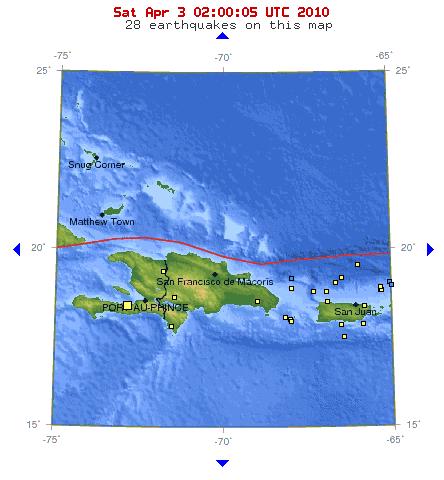
The USGS sent out an email report regarding an 8.0 quake near Higey, La Altagracia, Dominican Republic, but the internal link was broken.

Going directly to the USGS website shows no mention of the quake. Neither does a quick check of web, news, and blogosphere, which mainly consists of other people going "what the heck just happened?"

(Update: Apparently the report is indeed false.)

Undersea Volcano Could Destroy Italy


From The Australian:

Europe's largest undersea volcano could disintegrate and unleash a tsunami that would engulf southern Italy "at any time", a prominent vulcanologist has warned.
The Marsili volcano, which is bursting with magma, has "fragile walls" that could collapse, Enzo Boschi told the leading daily Corriere della Sera.

"It could even happen tomorrow," Prof Boschi, president of the National Institute of Geophysics and Volcanology said

"Our latest research shows that the volcano is not structurally solid, its walls are fragile, the magma chamber is of sizeable dimensions," he said.

"All that tells us that the volcano is active and could begin erupting at any time."

The event would result in "a strong tsunami that could strike the coasts of Campania, Calabria and Sicily," Prof Boschi said.

Thursday, April 1, 2010

Lord Howe Island's Bleached Reef Proves Climate Change


From ABC Australia:

Parts of the world's most southerly coral reef are under threat after it suffered its largest-recorded bleaching event.

Lord Howe Island is well known for its pristine environment and natural beauty.

The island's isolation has allowed it to develop unique and endemic marine life and the waters contain an unusual mix of tropical, sub-tropical and temperate corals.

But since January the waters around Lord Howe have experienced unusually warmer temperatures. The average rose by two degrees Celsius and the corals are showing the first signs of extensive bleaching.

And unlike the Great Barrier Reef, where corals have been known to recover, the genetically unique reef at Lord Howe could take decades to regenerate.

Peter Harrison from the Southern Cross University says it is the most significant bleaching event ever recorded at Lord Howe Island.

"The significance of this is that Lord Howe Island has the southern-most coral reef, so when that starts to see signs of extensive coral bleaching we know that the climate is definitely changing," he said.